Showing posts with label Gates. Show all posts

Monday, November 10, 2014

NEW COUSIN! Y-TEST RESULTS

R1b: Gates (Goetz) and Myers (Maier) origins

GATES MYERS Y-TEST RESULTS, OR LACK OF...
Hello Gates family, cousins, and interested readers. It's been a busy year or so for the Gates extended family. We've taken two Y-tests: one for GATES and one for MYERS. Thanks Bill and Gus for testing! And thanks to all those who donated to pay for the tests! We have waited patiently for the results. BOTH tests returned as haplogroup R-M269, or in old vernacular, R1b1a2.

With the same haplogroup, one might think that this meant that our Myers/Maier and Gates/Goetz ancestors were members of the same larger clan. They may have been part of the same larger population but that population appears to be all of western Europe. The haplogroup R1b1a2 is the dominant branch of R1b, the most common group in all Europe. Doesn't exactly pin down the ancestors.

And then we waited for exact matches who might give us some inkling of our German ancestors...and we waited...and waited...with not much to show.
The GATES 37-marker Y-test, in over a year and a half, has netted us exactly 7 matches, all only 12-marker tests ("low resolution"), with no 25 or 37-marker matching results and none with the surname GATES or GOETZ. Different surnames means that those 7 matches are from a time before surnames were adopted, so aren't of any use for genealogical searching. This is a bit of a disappointment.

The MYERS 67-marker Y-test, since Oct 2011, has produced over 1000 matches, but also all, except two, were 12-marker tests, and none had the name MYERS or MAIER or variant. A total of two 25-marker tests ("medium resolution") showed up as matches but, their names were Strassman and Baker.

Our closest match in all that time is an "almost-match." Although he didn't show up as an official match, I saw his results on The Myers DNA Project, his test listed one line below our Myers test. The almost-match is a descendant of a Franz "DOLLENMAYER," born 1821, Wurttemberg, Germany. Unfortunately, the tester has 12 markers that don't match our Myers/ Maier 67-marker test. Twelve mismatches of markers is 5 too many to be considered a match by the testing company.

On the 1870 Tuscarawas, Stark County, Ohio census, seven years before his death, Jacob Maier states his exact place of birth was Wurttemberg, Germany, in about 1810. Same place as our almost-match, Dollenmayer.
Might "Dollenmayer" have been a longer name that was shortened to "Maier" at some distant point in history? Is it a fantasy to think of a Mr. Dollenmayer getting tired of writing such a long name? Is it a fantasy to imagine ever getting a match for our German lines? There should be male descendants of our German lines out there, but where are they?

AUTOSOMAL DNA TESTS
On a more positive note, our lack of results in the Y-testing has been balanced by the exciting results of the Autosomal tests ("a-t" DNA). Autosomal testing is a new way of searching for ancestors and is becoming very popular.
The Y-test tracks the Y-chromosome which is passed from father to son only. The Mitochondrial DNA (mtDNA) test tracks the mother's line, from mother to daughter (and from mother to son, but only for one generation), but the Autosomal test (atDNA) looks at all the chromosomes, on all the lines, so a woman can take the test. Finally!

I have tested, and cousin Barb has tested, at 23andMe, so we are having fun seeing where we have DNA in common and seeing who it is who matches both of us.

Since Barb and I are first cousins, how much DNA should we have in common?
  • According to the mathematics of genetics, DNA divides approximately in half with each generation. We get about 50% of our DNA from each of our parents. We have about 50% DNA in common with our siblings. We have about 25% DNA in common with our grandfather, grandmother, aunt and uncle, as well as our nieces and nephews. Think about that for a moment. 25% of your DNA is the same as that of your grandmother or grand father. Your grandchild or your niece or nephew carries about 25% of you.
So first cousins should have about, on average, 12.5% DNA in common. But Barb and I have 14.7%!
We are on the high end of the statistical range of matching DNA for first cousins. My first very unscientific thought was that the Gates genes were probably extra-dominant.

Comparing to others at 23andME, it is most exciting to see that Barb and I have at least 2 other women who match both Barb and me on exactly the same segment of the x chromosome (the x chromosome determines gender). And the two women also match each other. That means that we all 4 have an ancestor in common. But one of the women knows little about her ancestry and the other woman's tree shows no obvious ancestors in common with the Gates lines. It's a challenge, at least, to find the connection.

And cousin Marilynn has tested at Ancestry.com and turned up as a match to me. They predict she is a "3rd-4th" cousin match but actually she is a "second cousin, once removed."
  • The "removed" means we're cousins of different generations. Marilynn's father, Carl Weiss, and A.J. Gates were first cousins (they were sons of siblings, Christina Barbara Goetz and John C.M. Goetz), so Marilynn and my mother, Connie, were second cousins. I would be a third cousin to Marilynn's daughter. So to Marilynn, I'm a second cousin, "once removed."
 I can't tell how much, or on which chromosome, Marilynn and I match because Ancestry does not share that information. To compare her test to my test, Marilynn would have to transfer her results to Gedmatch.com, a volunteer-run website that crunches numbers all day for free. My results are already posted there, happily generating comparisons to possible cousins at all hours of the day or night. It's the only place that results from all three companies can be compared to each other.

NEW COUSIN
Closer to the present, through Autosomal testing on FTDNA, I got a DNA match from a male second cousin with the surname BUNKER. He is descended from Albert Gates and Alvina Knapp's daughter, Mary Jane Gates, who lived in Louisville, KY. (Albert was A.J. Gates' brother and Mary Jane was Connie, Fran, Gus, Bill and Pat's first cousin.)

 I recognized the name Bunker immediately because I had seen Albert's death certificate and always wondered who the informant "Mrs. Thomas Bunker" was. I should have guessed it was one of Albert's children. Our other most recent new Gates cousins from Texas are also descendants of Albert, some from Mary Jane Gates Bunker and some from Mary Jane Gates' brother, Ned Gates, and sister, Ruth Gates Heath.

So our latest Bunker cousin matches DNA of both my two brothers (who also have both tested) and me. He would probably match Barb also, but he tested at FTDNA, not 23andMe. I can see Mr. Bunker's results on FTDNA but I can also compare our results on Gedmatch.com and take advantage of their analysis tools because we both transferred our results. He is also my "second cousin, once removed."
  • Connie and Mary Jane were first cousins, in the same generation. I'm the daughter of Connie but our new cousin is the GRANDSON of Mary Jane. If he were Mary Jane's son, he would be my second cousin, since children of first cousins are second cousins. New cousin Bunker and my daughter would be full third cousins (with no "removed"), both being in the same generation. 
  • New cousin Bunker and Marilynn, both second cousins, once removed to me, are "second cousins, 2 times removed" to each other. I confess, I used my genealogy software to calculate that.
So, welcome new Bunker cousin! All the Gates cousins on this list are happy to know of you!

Mary Jane Gates 1910-2002

The above photo is Mary Jane Gates, our new cousin Bunker's grandmother, in about 1925.

Doesn't she look just like we girls looked in the early 60's? I had that exact hair style in 1959! On second thought, maybe I had that hair style because it was my mother who was the one who arranged my hair that way, teaching me to set the little curls by twisting the hair around her finger and pinning it with bobby pins, like she and Mary Jane probably did in 1925 or so. How times don't change.

Here are the captions that teen-ager Mary Jane wrote on the back of this photo.

CAPTION
"Return in ? years to J M Gates 2114 Kenilworth, Louisville, KY.
This brings pleasant memories. J M Gates.
Henrietta Fallis. I have carried this picture since 9/12/25. Reward
8/3/27 Given to my Dearest cousin, 'Connie' "[Connie was 15 in 1927.]

I've had this picture in my collection for so long. Finally, I could share it with someone who it was connected to. Maybe I should add on the back of it, "I've carried this photo since 1958."
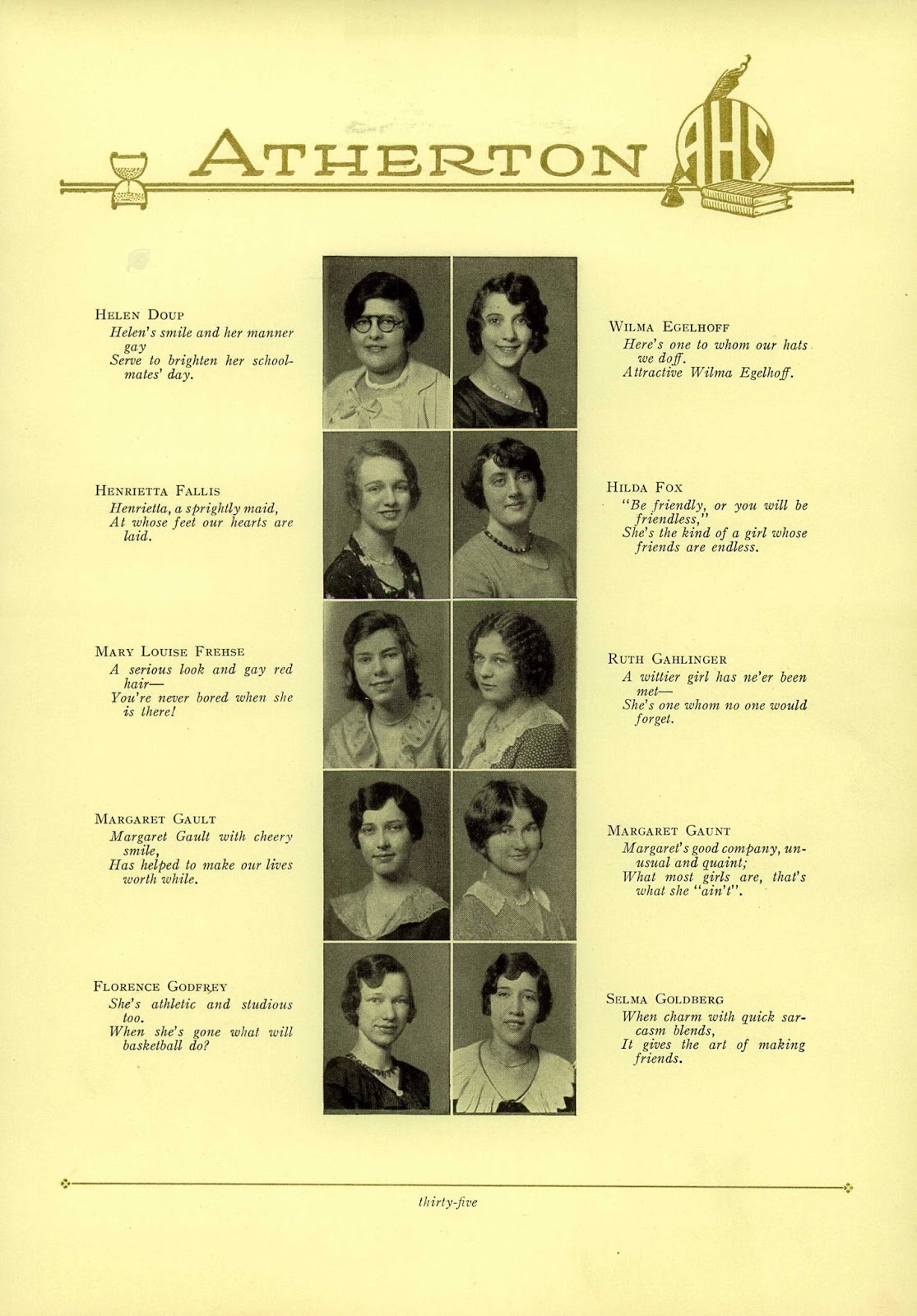
Bonus photo: Mary Jane's friend, Henrietta Fallis, from Atherton High School, Louisville, KY, 1930

Thursday, May 2, 2013

CHRISTOPH GOETZ, THE MAN WHO WENT TO WAR

Christoph Goetz, 1809-1857, abt age 47, Nuremburg, Germany

This photo is a scan, of a xerox, of a photo of Christoph Goetz (Gotz), born 1809, Nuremburg, Bavaria, Germany, who was the father of John Charles Marcus Gates (born Goetz).
John Charles Marcus Gates was born in Nuremburg, Germany in 1845 and immigrated in 1864, age 19, ending up in Louisville, KY. He was father of 8 children, including A.J. Gates, Albert Gates and Mabel Gates.
The story from my Nana (A.J. Gates' wife) was that Christoph Goetz told his wife, Anna Sibylla (Steffler) Goetz, that he was going to war and might not be back. If this photo is Christoph, it must have been taken shortly before he left. Not sure which war. There was a revolution in Germany in 1848. Not sure if this revolution continued up to 1857, the year of his death, in Nuremburg, or if he was injured and died later. With a uniform, one might think that he was in a German army, part of the government, that was trying to suppress the revolting 48-ers. Some detective work on the uniform might exactly date which army he was with.
In 1853, four years before his death and a few years after the revolution of 1848, considered by most to have failed,  his oldest son, Lawrence, was sent to America, at age 14, where he worked on a farm in Indiana.
1854 was the last year we know Christoph was with his family, since he conceived his last child, a son, who was born Dec.1854 in Nuremburg.
Being that the father was going to war around the same time that the sons were leaving for America might lead one to suspect that they might have been removing their sons to avoid their having to join the German army when they reached the age of conscription.
Seven years after Christoph died, his second son, John Charles Marcus Goetz, immigrated to America in 1864, at age 19, to be followed by Christoph's third son, Christopher Lawrence, who immigrated, the following year, in 1865, at age 17. The rest of their family, two sisters, Christina Barbara Goetz and her husband George Weiss; Margaret Goetz and her husband George Fiedler, their mother, Anna Sibilla (Steffler) Goetz and youngest brother, William J.C., followed in 1867. 
Who do you think he looks like? I think he looks like my Uncle Gussy (My mother's brother, son of A.J. Gates). How appropriate that we now have another ancestor face to go with the newly-determined Gates DNA haplogroup of R1b1a2!

Thank you, cousins in Indiana, for sharing this image with us.

Another photo below from our Indiana cousins.

This is John Charles Marcus Gates, wife Elizabeth (La Salle) and daughter Gertrude Gates Vogel at the grave of Christoph Goetz. Apparently Christoph did come back from the war alive. Caption on back says: "Our father's grave, Christoph Gotz, born Nov 17, 1809, died Oct 30, 1857."
From left: unidentified man (possibly John Charles Marcus Gates' German cousin, "Karl"?), John Charles Marcus Gates with the cane, Gertrude Gates Vogel, his oldest daughter (Gertrude was A.J.'s, Mabel's and Albert's older sister) and Elizabeth Lasalle Gates, his wife.

This photo below is from Connie Gates Markle's collection. She thought the man in the portrait frame might have been Christoph Goetz.
From left: Albert Gates, Elizabeth Gates, Mabel and Gertrude Gates (or Mabel and friend), John Charles Marcus Gates, and Charles Gates, holding portrait of unknown ancestor, possibly Christoph Goetz.

If only they had kept a diary, we might not have to wonder and guess what their reasons for their actions were. Yet, do any of us moderns consider keeping a diary to record the reasons surrounding our current life events?

Why not start today?


Copyright 2013
Jan Davis Markle


Sunday, February 20, 2011

Frances Lenore Myers is mtDNA haplogroup H7, "Helena"


Hello my dear Gates cousins and interested visitors,

In honor of my mother's birthday (yesterday), I am sharing some genealogy news about our mother line.

Our maternal line from Nana/Grandmother, Frances Lenore Myers, has been mtDNA (mitochondrial) tested (thanks to a Christmas gift from Kendra) and it is:

Maternal Haplogroup: H7(Specifically H7a1, a subgroup of H7. )

H is associated with northern Europe and is the most common haplogroup in Europe. It is also referred to as "Helena." 

The mtDNA test tracks the mitochondrial markers in a woman's DNA. This is the "umbilical" line, DNA which has been passed down identically in the mitochondria of each cell from mother, to daughter, to granddaughter, and on, in an unbroken line, for thousands of years!

When a mutation occurs in the mitochondrial DNA, which it does naturally, it is passed on to the next generation, creating a living record that tags those people carrying that DNA from then on. Scientists use this change in DNA, called a "marker," as a way of tracking where people lived at various times in history. All people with the same markers are categorized in groups called haplogroups.

This is deep ancestry, thousands of years ago. Brian Sykes in his book, 7 Daughters of Eve, tracks mitochondrial DNA back to 7 original women, who he calls "Ursula, Xenia, Helena, Velda, Tara, Katrine and Jasmine." These 7 lived from 20,000-45,000 years ago, the direct ancestors of all modern Europeans alive today!  Article on Brian Sykes and 7 Daughters of Eve

Of the 4 great-grandparents that we have in common, Gates/La Salle, Myers/Gorton, we know that the Goetz's came from Germany and La Salle we think was from Austria/Alsace Lorraine. The Myers/Maiers line was also probably from Germany.

Now, with this test, we learn that the fourth line, Nana/Grandmother's maternal line, although recently from Ohio, and before that, from the New Haven, CT, colony, was originally from northern Europe.

We could have guessed this since Nana/Grandmother's maternal great-grandmother, Emaline Hotchkiss, and Emaline's maternal ancestors, (the furthest back is Priscilla WHITSON) were all from the New Haven Colony in CT, whose settlers in 1638 were English.

If we follow the mother line, (the surname changes each generation because the daughter takes her husband's name), the names after Hotchkiss are all standard English names:  1GATES, 2 Frances MYERS, 3 Mary GORTON, 4 Frances ROBERTS, 5 Emaline HOTCHKISS 6 Hannah WOODING, 7 Hannah HOLBROOK, 8 Priscilla COLLINS, 9 Abigail THOMPSON, 10 Priscilla POWELL, 11 Priscilla WHITSON.  (See chart below of the mother line from Connie Gates to Priscilla Whitson.)

The New Haven Colony was formed in 1638 by a group of Puritans who wanted a STRICTER religious governance than existed in Massachusetts Bay Colony! Priscilla Whitson either came from England or was already in Mass. Bay Colony when the New Haven colony formed. Their theocracy in New Haven, a government based entirely on religion, only lasted one generation. In 1664, they joined with the Connecticut Colony which was secularily-based and much more tolerant of other religions.

What is interesting is that this maternal line, which has been reproducing for 40,000 years or so, is in danger (in our family) of dying out. Since it is only passed from mother to daughter, only the daughters of Nana/Grandmother's daughters carry it. That would be Connie's and Fran's daughters. We know who we are!

Connie and Fran's 4 daughters have produced 5 daughters (and 4 sons) born since 1966, and none of these daughters have had any daughters of their own, only sons. True, there is still time and women are having children later in life these days, but it's looking like the Gates mother line may not survive in our family.

Of course our entire H line will not die out. If any of the sisters of any of our ancestors had daughters (like Mary Gorton's sister, Ella; Frances Lucinda Roberts' sisters, Mary Ann, Emma and Ellen; or Emaline Hotchkiss' 5 sisters...), then they would also carry the same H line down through their daughters.

So think on those things dear Gates cousins. Perhaps when Sharon goes to the LDS library this week she may find more on the origins of Priscilla Whitson, the furthest back we go on the maternal line. Priscilla Whitson was born about 1616, married Thomas Powell in 1637 and came to the New Haven, CT, Colony in 1638 when it was formed. But where was she from?

And for the Gates males who might be feeling left out, why don't we do a Y DNA test (cost is about $240), and we could all see where the Goetz line has traveled. Not only would we find out where our distant Goetz men originated, but we might find some other Gates relatives who match our DNA who we didn't suspect existed.  All we need is one male, who carries the Gates name, to test.

The oldest one is usually the best one to test, since younger men may have already had a mutation, but younger ones will do.  We could even chip in if the cost seemed high. 15 of us at $15 each would do it. Do we know any Gates men who might be interested in spitting in a vial to find out something about our ancestry? I have discovered my Davis paternal line by having my brother take the test so would love to give advice.

An interesting springtime project?

For those of you who want to read more, here's some info on the H haplogroup of Nana/Grandmother's maternal line from the 23 and Me website. Will let you know if I find any significant matches to my test. Maybe we have a H7 cousin out there?

Maternal Haplogroup:H7. H7 is a subgroup of H.
The Mother of all Mothers (the MoM), our common maternal ancestor, lived in Africa about 175,000 years ago.

Chart below is Locations of haplogroup H circa 500 years ago, before the era of intercontinental travel.
Map of Haplogroup  
H originated in the Near East and then expanded after the peak of the Ice Age into Europe, where it is the most prevalent haplogroup today. It is present in about half of the Scandinavian population and is also common along the continent's Atlantic coast.
Haplogroup: H, a subgroup of R0
Age: more than 40,000 years
Region: Europe, Near East, Central Asia
Populations: Basques, Scandinavians
Highlight:  Mitochondrial DNA extracted from the remains of St. Luke belonged to haplogroup H. 
Haplogroup H dominates in Europe, reaching peak concentrations along the Atlantic coast. It is also common in many parts of the Near East and Caucusus Mountains, where the haplogroup can reach levels of 50% in some populations. H originated about 40,000 years ago in the Near East, where favorable climate conditions allowed it to flourish. About 10,000 years later it spread westward all the way to the Atlantic coast and east into central Asia as far as the Altay Mountains.
About 21,000 years ago an intensification of Ice Age conditions blanketed much of Eurasia with mile-thick glaciers and squeezed people into a handful of ice-free refuges in Iberia, Italy, the Balkans and the Caucasus. Several branches of haplogroup H arose during that time, and after the glaciers began receding about 15,000 years ago most of them played a prominent role in the repopulation of the continent.
H1 and H3 expanded dramatically from the Iberian Peninsula, along the Atlantic coast and into central and northern Europe. Other branches, such as H5a and H13a1, expanded from the Near East into southern Europe. After a 1,000-year return to Ice Age conditions about 12,000 years ago, yet another migration carried haplogroup H4 from the Near East northward into Russia and eastern Europe.
Haplogroup H achieved an even wider distribution later one with the spread of agriculture and the rise of organized military campaigns. It is now found throughout Europe and at lower levels in Asia, reaching as far south as Arabia and eastward to the western fringes of Siberia.
Royal LinesBecause it is so common in the general European population, haplogroup H also appears quite frequently in the continent's royal houses. Marie Antoinette, an Austrian Hapsburg who married into the French royal family, inherited the haplogroup from her maternal ancestors. So did Prince Philip, Duke of Edinburgh, whose recorded genealogy traces his female line to Bavaria.

Mother line from GATES to WHITSON
Haplogroup H7a1
(Click on chart twice to enlarge.)
Photos and text copyrighted 


Sunday, May 2, 2010

The Goetz Story in Nuremberg, Germany


May 2, 2010

Hello my dear Gates cousins and interested visitors-

We have traced the name GATES from Cincinnati, Ohio to Nuremberg, Germany and found the spelling of the name changed as it went back in time from GATES to GOETZ, to GÖTZ, to GÖZ. We have found that the name GOETZ, GÖTZ, and GÖZ are all pronounced “gets, as in Stan Getz, or “guts,” meaning pet form of “good” or “God” in German.

But we have left out half of the family- the wives! Each wife is another character in our family story and she represents another family surname to study. Who were these wives and where did they come from?

The only way to find these wives is by searching just a few church records listing marriages, births and deaths of four generations. Besides the names and dates, all we really know from these records is the town in which the birth, marriage or death occurred and the occupations of the fathers. Apparently, not much to build a riveting story upon but nonetheless, if you read on, you’ll find mystery, revolution, serendipity, discovery and surprise, all derived from just these plain facts.

The quickest way to meet all the main characters in our Goetz story is to see their relationships on a chart. Below is a pedigree chart of John Charles Marcus GATES (at birth: “Johann Karl Markus GÖTZ”), our great grand-father. (family surnames are color-coded.)

(Click 2x on chart to enlarge)

On the chart you will see that we have three generations of paternal GOETZ/GÖTZ ancestors but only one generation of ancestors on the maternal STEFFLER line.

On the GÖTZ side, we have three other surnames of the wives: ORFF, WEISSPOMCRAZ (WEIßPOMCRAZ in German), and ZELTNER, each representing other ancestral lines.

The two recent GÖTZ men were filemakers, as was the ORFF family, but the earlier GÖTZ men were blade sharpeners. The ZELTNER and STEFFLER men were spur-makers, and the WEISSPOMCRAZ was a trader. Except for the trader, their occupations were all involved with metal and perhaps even the trader, if he traded metals.

THE GOETZ STORY in NUREMBERG, GERMANY

We’ve got the characters, so now we need the setting. We know the story takes place in Nuremberg, Germany. It seems that Nuremberg was fortuitously situated on both the east/west and the north/south European trade routes and so became a hub of prosperous trading. Thus, the old German proverb: "Nuremberg's hand goes through every land."

Despite “the town had no vineyards nor was the Pegnitz a navigable stream and the soil was poor” (reasons given to King Frederick in 1219 when requesting his protection of the town), by the end of the fourteenth century, Nuremberg became the main European producer of metal ware due the abundant iron ore deposits of the Upper Palatinate, newly acquired territory at its northeastern edge.

Woodcut of Nuremberg from the Nuremberg Chronicle, 1493 (-Wikipedia)

Cliff-notes, condensed version of the Goetz story with colorized surnames

The oldest records show that the Johann Orff and Alexander Zeltner families lived in Nuremberg to start with, around 1720. The Orffs were filemakers and the Zeltners were spur makers, both metal workers. Might their families have been associated with each other because they were both metalworkers? The Zeltner spur maker daughter, Margareta, marries the Off file maker son, Christoph, in Nuremberg in1773 and they had an Orff daughter, Anna Barbara, who was waiting in Nuremberg for the Götz boy to come along.

Seven miles outside of Nuremberg, in Gerasmühle, the Nicolaus Göz family men were blade sharpeners in the early 1700’s. The Göz son, Heinrich, married Maria, the daughter of a Jacob Weisspomcraz, a trader from Schweinau, a town two miles outside of Nuremberg, in 1762 and they had a Götz son, Johann, who moved closer in to the center of Nuremberg. Johann became a file maker, perhaps working with the Orff file maker family. He marries the waiting Anna Barbara Orff file maker daughter in 1798. They had a Götz son, Christoph, in 1809, who also became a file maker. This Christoph Götz then married Anna Sibylla, a daughter of a Spur maker, Lorenz Steffler, in 1838. It was this couple, Christoph Götz and Anna Sibylla Steffler, who lived through the years leading up to the revolution of 1848 and who had the 6 Götz children who all came to Angola, Indiana.

Now that you have a rough idea of the people in this Goetz clan, perhaps you’d be interested in following the more detailed story about the individuals, the action of the story.

Generation Four: John C.M. Gates’ Parents

The parents of our great grandfather, John C. M. GATES, were Christoph GOETZ (GÖTZ), the “Feilenhauermeister” (master file maker) and Anna Sibylla STEFFLER. They were married 13 Feb. 1838 at St. Jakob's church in Nuremberg, Germany.

St. Jakob’s Church Nuremberg, Germany

Christoph died in Germany in 1857 but his wife and four sons, Lawrence, John C.M., Christopher, William and two daughters, Margaret and Christina Barbara, immigrated to Angola, Indiana between 1853 to1867.

Generation Three: John C.M. Gates’ Maternal Grandparents

The marriage record of Christoph GÖTZ and Anna Sibylla STEFFLER, lists Anna Sibylla as the "Tochter" (daughter) of the "Spornmeisters" (master spur makers) Lorenz STEFFLER and Anna Margaretha.

Lorenz STEFFLER was the grandfather who brought the first of the GÖTZ family, Lawrence GATES (John C.M. GATES' older brother) to Angola, Indiana in 1853, dropped him off and then left him there at age 14, presumably with friends. On the 1860 Angola, Indiana census, Lawrence, age 21, is living with the Ebenezer JOHNSON family and is listed as a farm laborer.

Why Angola?

This remains a mystery. Was Angola a town that was populated with many Germans? Did the GÖTZ family have a friend there that would apprentice their son? And why that particular age? Was the GÖTZ family trying to avoid some required German military training since the boys immigrated at ages 14, 19 and 17 in 1853, 1864 and 1865?

Perhaps the GÖTZ family might have been one of the many skilled and educated German families who gave up on Germany after the failed revolution of 1848. "Forty-eighters" they were called- they were the thousands who streamed to America in hopes of a country "freer" than their own after the revolution that "never happened." Was this the "war" that our family oral history referred to?

“Disappointed at the failure of the revolution to bring about the reform of the system of government in Germany or the Austrian Empire, and sometimes on the government's wanted list because of their involvement in the revolution, they gave up their old lives to try again abroad.”-Wikipedia


Could the “wanted list” of the authorities be the part of our family legend that hinted at our ancestors “escaping from the government?”

So many Germans came to the US after 1848 that certain U.S. cities had whole sections that completely replicated German life. Cincinnati, Ohio, where John C.M. Gates lived and Milwaukee, Wisconsin, where John C.M.’s younger brother, Christopher Gates, first lived, were two such cities.

More than 30,000 Forty-Eighters settled in the Over-the-Rhine neighborhood of Cincinnati, Ohio … many German Forty-Eighters settled in Milwaukee, Wisconsin, helping solidify that city's progressive political bent and cultural Deutschtum. The Acht-und-vierzigers [“eight and forty”] and their descendants contributed to the development of that city's long Socialist political tradition.-Wikipedia

Angola, Pleasant Township, Steuben County, Indiana

After their father, Christoph, died in 1857, John C.M. GÖTZ came to the U.S. in 1864, at age 19, and his younger brother, Christopher came a year later in 1865, at age 17, both changing their name from GOETZ/GÖTZ to GATES. It would be another 10 years before Christoph's widow, Anna Sibylla GÖTZ, would come with her two married daughters, Margaret and Christina Barbara and their husbands, Herman FIEDLER and Georg Leonard WEISS, and Anna's youngest son, William, age 12, to join their brothers in the same town of Angola, Indiana, in 1867.

Many educated Germans arrived in the U.S. only to discover they couldn’t find any work.

“…men who were at home in every branch of learning were forced to support themselves…by making cigars, acting as waiters or house-servants, boot-blacks or street-sweepers…” -Carl Wittke, Refugees of Revolution: The German Forty-Eighters in America, Philadelphia: Univ. of Penn. Press, 1952, www.archive.org

Our Gates men were lucky. John C.M. worked first as a clerk, then as a distillery salesman in Cincinnati, Ohio and Christopher became a civil engineer in Milwaukee, Wisconsin and Toledo, Ohio. Their oldest brother Lawrence served in the Civil War and then worked in dry goods, then banking and fire insurance in Angola, Indiana and their youngest brother, William, eventually became a tailor, also in Angola.

Generation Three: John C.M. Gates’ Paternal Grandparents

John C.M. GATES' paternal grandparents were Johann Wolfgang GÖTZ, a Feilenhauer (file maker), and Anna Barbara ORFF. Johann and Anna Barbara were married at the St. Lorenz church in Nuremberg, Germany in 1798.


St. Lorenz Church, Nuremberg, Germany

Johann Wolfgang GÖTZ was from a different part of Nuremberg known as Gerasmühle, about 7.5 miles southwest of the center of Nuremberg. Johann Wolfgang GÖTZ and Anna Barbara ORFF had nine children, born between 1799 and1811, including one set of twins. Christoph, John C.M. GATES' father, was the 8th child of that family.


According to records from the St. Lorenz and St. Jakob’s Churches in Nuremberg, Christoph
GÖTZ ' 8 siblings were: Johann Benedikt, Margareta Barbara, Conrad Christoph, Johann Georg, Maria Barbara, Heinrich and Ursula Margareta (twins), and Conrad Wolfgang.

Church records show that three of these GÖTZ siblings married: Conrad Wolfgang Götz married a Maria Sabina BAYERLEIN in 1846. Johann Georg Götz married a Christina Barbara BACKRASS in 1832.

Here’s the Serendipity…

And in 1823, Margareta Barbara Götz married a Johann MERKEL! (Small world!) Any of these married siblings might have living descendants who would be our German cousins, maybe even living right now in Nuremberg!


Generation Two: John C.M. Gates’ great grandparents

John C.M. GATES’ great grandfather (father of Johann Wolfgang GÖTZ) was Heinrich GÖZ, a “Klingenschleifermeister,” (master blade sharpener) from Gerasmühle. Note the name GÖTZ was then spelled GÖZ. Heinrich GÖZ’s wife was Maria Magdalena WEISSPOMCRAZ. They married in 1762 at St. Leonhard’s Church.

St. Leonhard Church, Schweinau, Germany

John C.M. GATES’ other set of known great grandparents (Anna Barbara ORFF’s parents) were: Christoph ORFF, a “feilenhauermeister,” and Margareta Barbara ZELTNER. They were married in St. Lorenz Church in 1773, three years before the Declaration of Independence was signed in Philadelphia, PA.


Generation One: John C.M. Gates’ great, great grandparents


From Heinrich GÖZ and Maria Magdalena WEISSPOMCRAZ's marriage record we learn that Heinrich was the son of Nicolaus GÖZ, a “Klingenschleifermeister,” master blade sharpener, from Gerasmühle. We also learn that Maria Magdalena WEISSPOMCRAZ was the daughter of Jacop WEISSPOMCRAZ, a "handelsmann" (trader) from Schweinau, a town 2 miles outside the center of Nuremberg.

From Christoph ORFF and Margareta Barbara ZELTNER's marriage record, we learn that Christoph Orff’s parents were Johann ORFF, from Nuremberg and Margareta Barbara.

We also find that Margareta Barbara ZELTNER's father was Alexander ZELTNER, of Nuremberg, and her mother was Barbara. A lot of Barbara’s. Notice how the names Christoph, Johann, Lorenz, Anna, Margaret and Barbara repeat through the generations? Alexander ZELTNER is listed on their marriage record as a “Spornmeister” or master spur-maker. This is as far back that our GOETZ German ancestors go. They would be our great, great, great, great, great, grandparents!


ZELTNER seems to be a prominent name in Nuremberg. Not sure if any of these Zeltners are related or not, but in 1877 in Nuremberg, a Johannes ZELTNER was awarded a patent for producing synthetic ultramarine red. In 1716, in Nuremberg, Johann Conrad ZELTNER published the biographies of 100 proofreaders. And in 1722, in Nuremberg, Gustav Georg ZELTNER, a Protestant theologian, published books on M. Luther and was a Christian scholar on Hebrew literature. Anyone want to do some research and see if these ZELTNERs are related to our Alexander?

Is there anything to discover from all this history?

If you’re wondering how knowing about all these events from the past might change who you think you are, well, you might be surprised by this:

The family story handed down to me about our Goetz history was that our “stern great grandfather” (John C.M. Gates) was the driving force of our family’s Catholic orientation and that he had left Germany because of religious persecution.

John Charles Marcus Gates

Yet this history of religious persecution does not seem fit the facts of our family history. Here’s why:

  1. Anna Sibylla Gates, John Charles Marcus Gates’ mother, lived in Angola, Indiana until she died on April 29, 1898, at age 83. Her Angola obituary says "...she was a member of the German Lutheran church since early childhood..." and her funeral was in an Angola Methodist Church. Her birth certificate says she was baptized “according to the Evangelical-Lutheran rites.”

  1. Although originally Catholic churches, St. Lorenz and St. Jakob, the churches in Nuremberg where John C.M. Gates’ parents, Anna Sibylla and Christoph GÖTZ, were baptized, married and where their children were baptized (and the same the churches in which the earlier generations of GÖTZ, ORFF, WEISSPOMCRAZ and ZELTNER families were baptized, married and buried), these churches were Protestant since the time of the Reformation, about 1517!

Nurnberg, 1575

These facts give us good reason to believe that John Charles Marcus GATES was Protestant by birth and converted to Catholicism probably when he married Elizabeth LaSalle Meyers, our great grandmother, in 1870, only a short 6 years after he arrived in the US.

Elizabeth LaSalle Gates was always referred to as a "strong Catholic" by her daughter-in-law, Frances Lenore (Myers) Gates and, in her photographs, Elizabeth is often seen wearing a large cross on a necklace.


Did Elizabeth’s Catholicism come from her parents? Although Elizabeth’s father, Ernest Robert LaSalle, was from France, Elizabeth’s mother, Barbara Hemerling, was from Wurttemberg, Germany and Elizabeth's adopted father, Andrew Meyers, was from Hesse-Darmstadt, Germany. Were these areas where Catholics were dissatisfied with minority treatment in Protestant Germany and wanted to emigrate? More research into the history of Catholics in Germany is clearly necessary!

All of our upbringings have always had a strong Catholic theme, passed down from our parents, passed down from their father, Augustus J. Gates, who was Elizabeth's seventh child. Does it surprise you to consider that all our family's Catholicism derived from Elizabeth LaSalle instead of from her husband, John C.M. Gates? Doesn’t THAT change the way you see yourself?


Elizabeth LaSalle Meyers Gates


by Jan R. Markle


geneablog

Here you'll find: information that usually goes out to the Gates Cousins email list, biographies of special characters as they are discovered and added to the family tree, research histories of select cases, questions and wonderings about hard-to-solve
searches and other miscellaneous thoughts about genealogy and its mysterious ability to transcend time, changing us hundreds of years after the changing event occurred.